
Two EVs at Home: Sharing Charging Without Guesswork
Two EVs do not automatically require two chargers operating at maximum output.
Quick answer
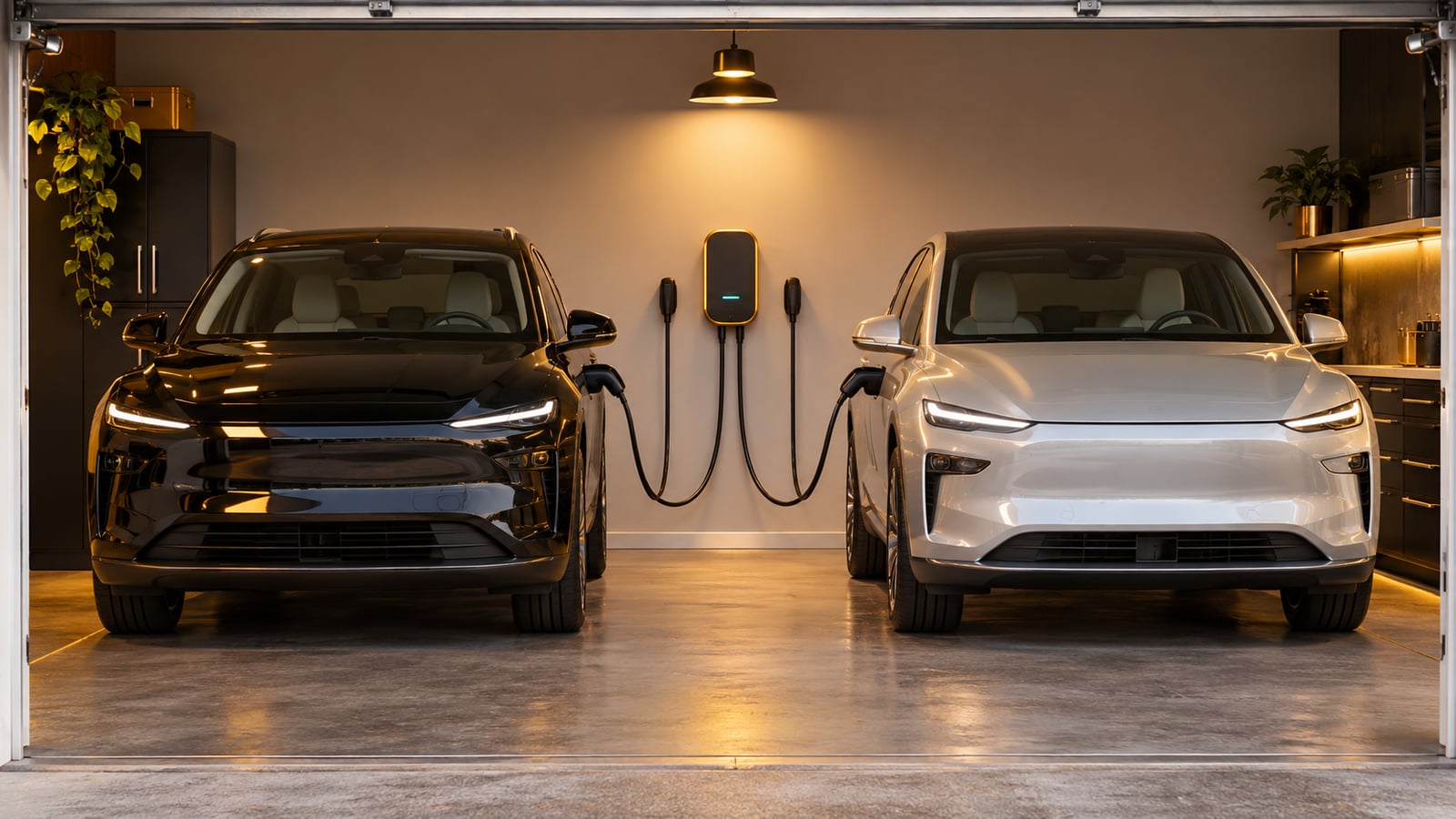
Two EVs do not automatically require two chargers operating at maximum output. Plan around each vehicle's daily energy use, parking times, and the home's available electrical capacity. Suitable options may include scheduled use, compatible power sharing, or separate circuits, but the complete arrangement needs professional assessment.
Start with two driving routines
Record when each vehicle normally arrives and leaves, how much it drives, and whether either vehicle regularly needs a quick turnaround. A household with staggered schedules has different needs from two long-distance commuters who both arrive late.
Also consider charge-port locations and parking flexibility. A technically adequate charger is inconvenient if vehicles must be moved every evening or a cable crosses a walking route. Draw the usual parking positions before choosing mounting locations.
Compare arrangements
| Arrangement | Potential advantage | Question to resolve |
|---|---|---|
| One charging point used at different times | Less equipment and simpler parking infrastructure. | Can both drivers reliably share the available window? |
| Compatible chargers sharing a defined supply allocation | Charging can be distributed between vehicles. | What total power and compatibility rules apply? |
| Separate charging circuits | Independent connection points. | Can the service support the assessed combined demand? |
Power sharing between chargers is not automatically the same as management of the entire household load. Ask which function the proposed system performs.
Model an ordinary day and a difficult day
An ordinary weekday may be easy to replenish. Also discuss the occasional day when both vehicles return with low batteries before an early departure. Decide whether slower replenishment, public charging, or a larger installation is acceptable for that situation.
Do not size the project only around a rare worst case without understanding its cost, but do not ignore a pattern that happens every week. Make the compromise explicit so the installation matches household expectations.
Confirm equipment behavior
Ask whether mixed vehicle brands can use the proposed connectors and charging equipment. Verify how power is shared, whether either vehicle has priority, and what happens when one finishes. Connected features may depend on communication; understand the behavior if that connection is lost.
Keep installer-configured limits intact. Changing app settings or adding another charger later can change the electrical design. Have modifications reviewed rather than assuming the original assessment covers them.
Plan the electrical work once
Tell Christopher Power Systems that the project involves two vehicles, even if only one charger is being installed initially. An assessment can compare suitable capacity and routing options and identify what would be needed for the second phase.
Ask for the expected charging behavior, circuit scope, and any service or management equipment in writing. That makes the proposal useful to both drivers rather than only describing hardware.
Balancing two vehicles and house loads?
Every property is different. Get guidance specific to yours.
Frequently Asked Questions
Straight answers to what homeowners and businesses ask us most.
No. Actual loads, charging rates, parking windows, and suitable management options determine the need.
No. Use a compatible, manufacturer-supported arrangement designed for the installation.
Not if they share a limited allocation or the vehicles cannot accept the available rate. Confirm the simultaneous charging performance.
Sun or storms, we have you covered
Get a free, no-pressure power assessment tailored to your property and priorities.