
How to Compare Solar Quotes Beyond Price per Watt
Compare solar quotes by system design, expected production, included electrical work, ownership terms, and service responsibilities—not price alone.
Quick answer
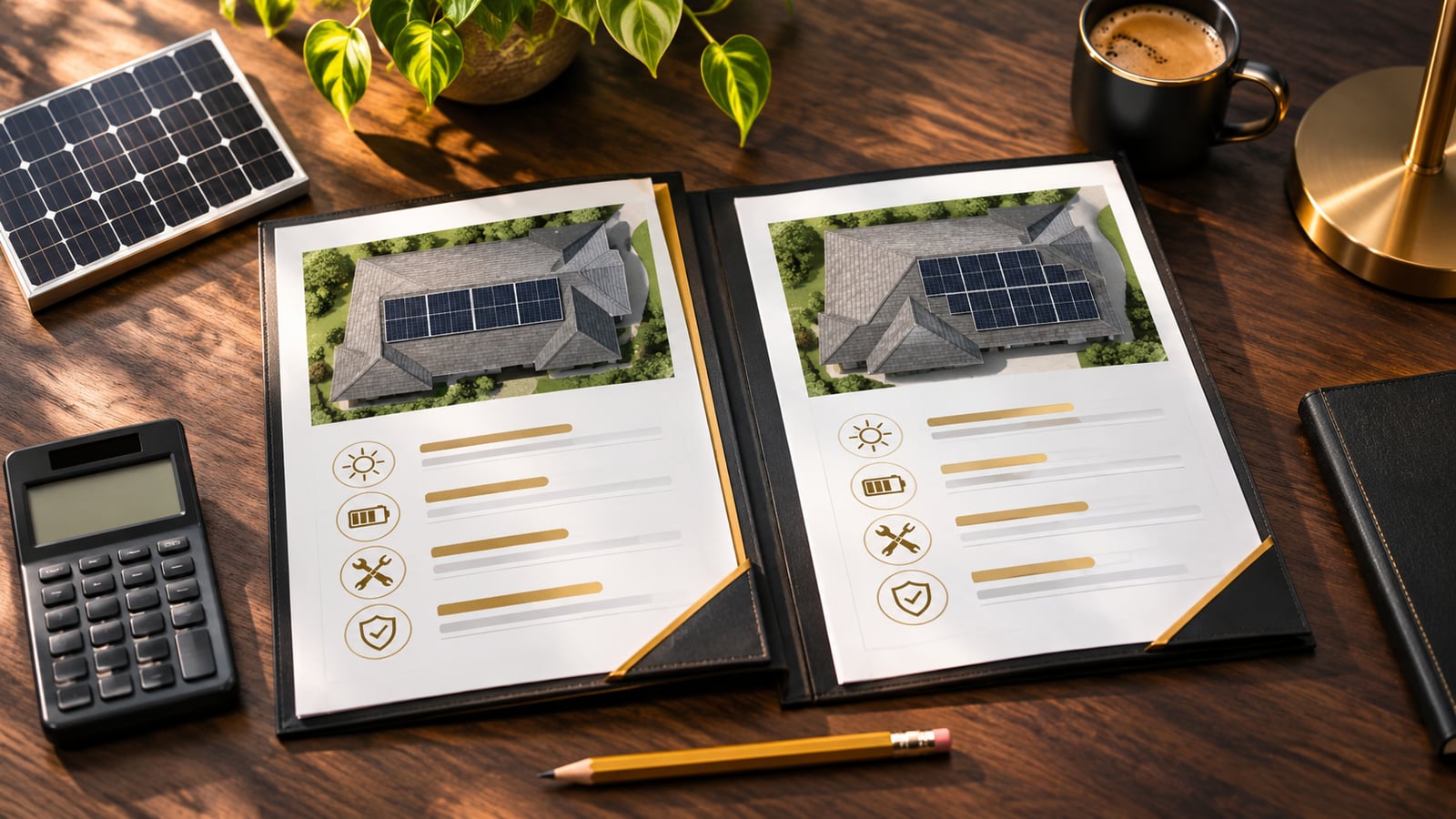
Compare solar quotes by system design, expected production, included electrical work, ownership terms, and service responsibilities—not price alone. Two proposals with the same panel count can deliver different outcomes. Ask each provider to explain the assumptions behind its estimate and identify what is excluded.
Put proposals on a common basis
Record the cash price, proposed equipment, system capacity, modeled annual production, roof layout, and any battery scope. If one proposal includes financing and another does not, separate the installation comparison from financing terms.
Also compare the goal. A system intended to reduce annual grid purchases differs from one designed with selected outage backup. A lower price can simply mean that less equipment or a different function is included.
Use a comparison worksheet
| Item | Question to ask |
|---|---|
| Production estimate | What shading, orientation, losses, and weather assumptions are used? |
| Equipment | What exact panels, inverters, and monitoring are proposed? |
| Electrical scope | Are panel changes and interconnection work included? |
| Roof and access | What assessment and restoration are covered? |
| Utility process | Who submits documents and waits for permission to operate? |
| Service | Who handles equipment issues and what terms apply? |
Read warranty categories separately
A product warranty, workmanship warranty, and production guarantee are different commitments. Ask for the actual documents, exclusions, duration, responsible party, and claim process. Do not assume a long product warranty means every service visit, labor charge, or roof issue is covered.
If equipment must be removed for future roof work, ask how that would be handled. A proposal should not imply that panel ownership eliminates future maintenance or access costs.
Challenge unexplained savings assumptions
A savings model can depend on future utility rates, export credits, consumption changes, financing, and maintenance assumptions. Ask which values are current facts and which are projections. If an estimate assumes every generated unit offsets retail electricity purchases, verify that this matches the actual utility arrangement.
You do not need to reject every forecast; you need to understand its sensitivity. Compare a conservative scenario as well as the headline result. Do not treat modeled savings as guaranteed cash income.
Watch for missing decisions
A quote may leave roof suitability, electrical upgrades, or utility approval unresolved. That can be legitimate early in the process if the uncertainty is clearly stated. It becomes a problem when a preliminary number is presented as a complete fixed scope without those checks.
Christopher Power Systems can discuss a solar design and explain its proposed scope. Bring other proposals if you want to compare the technical questions, while keeping the assessment focused on documented differences rather than unsupported claims about competitors.
Evaluating different solar designs?
Every property is different. Get guidance specific to yours.
Frequently Asked Questions
Straight answers to what homeowners and businesses ask us most.
No. Compare similar equipment, scope, production assumptions, and service terms first.
Not necessarily. Different layouts and assumptions can produce different forecasts. Ask why they differ.
Only if storage serves an identified goal and the design supports it. Backup and energy shifting should be evaluated separately from solar generation.
Sun or storms, we have you covered
Get a free, no-pressure power assessment tailored to your property and priorities.