
Hardwired vs. Plug-In EV Chargers: Installation Tradeoffs
Hardwired and plug-in EV chargers can both be appropriate when the equipment and installation are designed for the connection method.
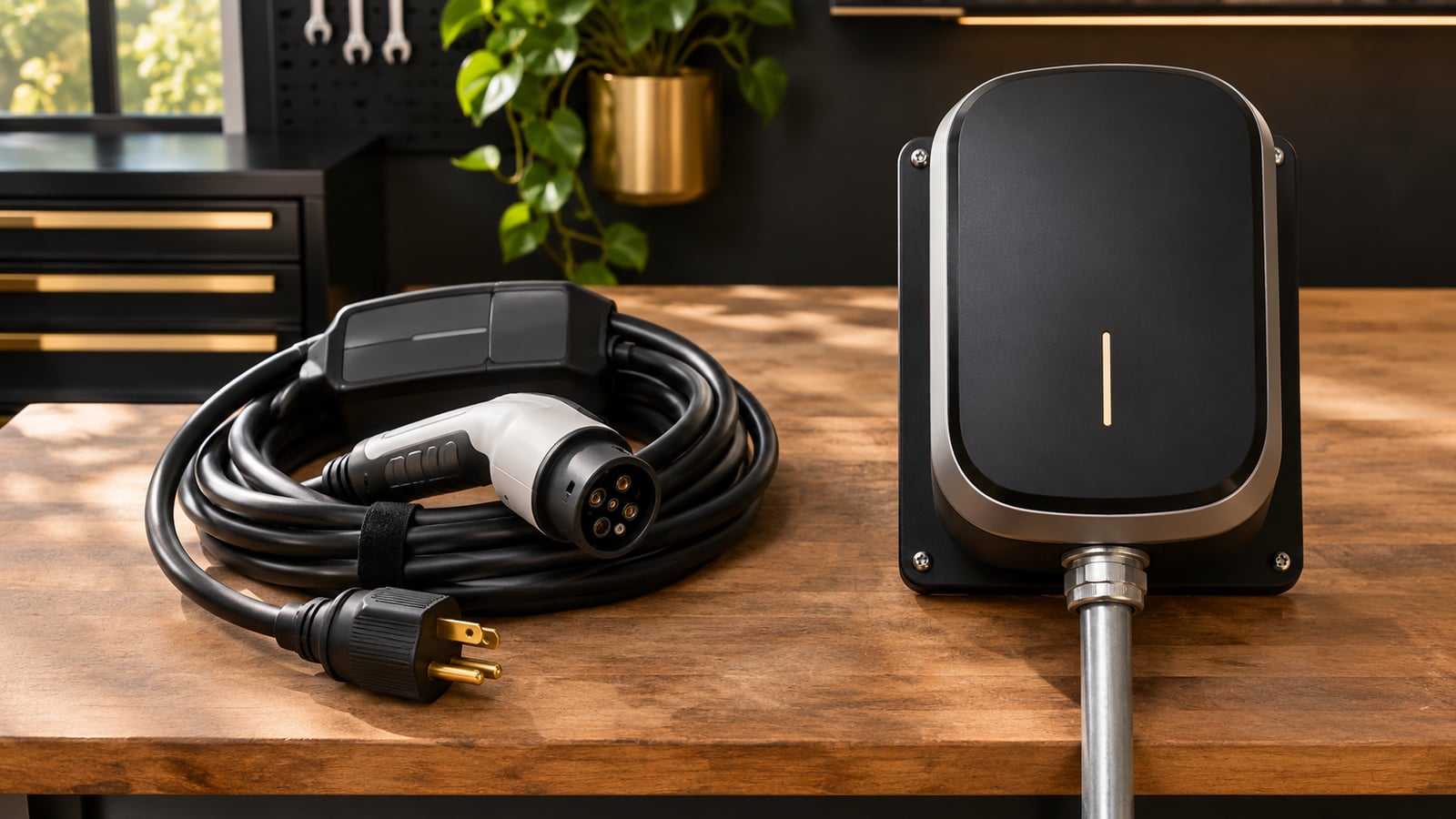
Quick answer
Hardwired and plug-in EV chargers can both be appropriate when the equipment and installation are designed for the connection method. Hardwiring connects the equipment directly to the circuit; a plug-in arrangement uses a suitable receptacle. Compare electrical requirements, charging rate, location, maintenance, and portability before choosing.
Compare the practical tradeoffs
| Question | Hardwired arrangement | Plug-in arrangement |
|---|---|---|
| Connection | Permanent circuit connection by the installer. | Compatible plug and receptacle within an approved installation. |
| Moving equipment | Removal generally involves electrical work. | Equipment may be more portable, subject to compatibility. |
| Installation details | Manufacturer wiring and configuration requirements apply. | Receptacle, plug, circuit, and protection requirements all matter. |
| Charging performance | Depends on equipment and circuit design. | Also limited by the approved plug-in configuration. |
Do not infer that one style is automatically safer, cheaper, or faster for every site. The complete installation determines suitability.
A receptacle adds another component to evaluate
A plug-in charger relies on an appropriate, correctly installed receptacle and connection. An existing outlet's shape does not prove its condition or circuit suitability for EV charging. Have the electrician evaluate it rather than adapting the charger to whatever happens to be present.
Do not use extension cords, improvised adapters, or unapproved connection changes. Follow the exact equipment instructions, including any limitations on mounting, cord routing, and use outdoors.
Consider how the vehicle is parked
The charger should be located so the cable reaches comfortably without becoming a trip hazard or being pinched by a door. Think about different vehicle charge-port locations and whether another EV may use the space later.
Outdoor equipment needs the appropriate rating and installation. Snow storage, driveway use, drainage, and ordinary vehicle movements belong in the placement discussion. Hardwiring does not remove these site considerations, and a plug-in arrangement does not make indoor-only equipment suitable outside.
Compare the complete installed proposal
Ask what equipment, circuit work, protection, mounting, and setup are included. Confirm the charging rate that will actually be configured. A wall unit's maximum advertised output may not be the rate available in the proposed connection arrangement.
If portability is important, explain where you expect to use the charger. Compatibility and available supply at that other location still need verification. “Portable” does not mean universally usable.
Make the decision before installation
Christopher Power Systems provides Level 2 charging installation. Share your vehicle, parking layout, and preference for permanent or movable equipment. The installer can explain suitable options and the electrical work associated with each.
Keep the installed configuration and equipment documentation. If you later change the charger or connection style, have the circuit and configuration reviewed rather than assuming the old arrangement remains appropriate.
Selecting connection style?
Every property is different. Get guidance specific to yours.
Frequently Asked Questions
Straight answers to what homeowners and businesses ask us most.
Only if the manufacturer permits that configuration and the installation meets the applicable requirements. Do not modify equipment to improvise a conversion.
Not automatically. Circuit use, condition, location, protection, and equipment compatibility need professional review.
No. The vehicle, equipment, circuit, and configured rate all limit charging performance.
Sun or storms, we have you covered
Get a free, no-pressure power assessment tailored to your property and priorities.